
How to make a mood board that ends in a design decision
A bookshop needs a poster for a late reading. Neon lettering, a navy book cover and a warmly lit window all suggest night, yet each invites a different response.
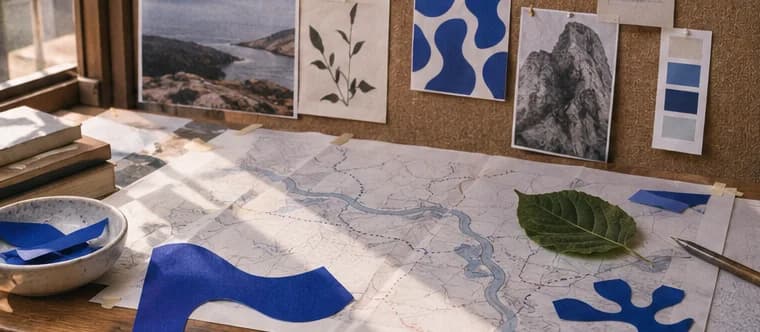
Write the decision at the top
Ask the bookseller what a passer-by should understand through the glass. If the answer is “come in and sit down”, the illuminated seat has a job. Assign the neon to distance legibility and the cover to paper colour. Set aside any reference whose job you cannot name.
Under the neon sign, put a note that says “read the words evening reading from across the street”. Under the book cover write “test a blue paper that absorbs light”; under the window photograph, “show that there is a seat inside”. Leave an open question beside the board: the actual door is on the right, so will an arrow appear to send people across the road? Keep creator and source with each reference so a later decision to reproduce an image has a clear starting point.
Give both directions the same brief
Print two small posters with identical titles, times and dimensions. Centre the bright window on one and give lettering the space on the other. Hang each in the same window, then cross the street to look.
Try the samples after turning on the shop lights. A reflection of the sign opposite can swallow the chair in a window that looked beautifully luminous on a monitor. Back both proofs with the same white sheet and look again from near the door handle. If that brings the chair back, settle the stock and backing before attributing the improvement to the composition.
Record what the next draft needs
Ask someone outside the meeting what each poster invites them to do. Save the observation alongside the chosen sketch. “Keep the chair and move the time into the light” gives the designer an edit they can actually make.
On a Haivis canvas you can keep the references, sketches and installation photographs together. Beside each sketch, record what someone actually said. If a passer-by expects a sale, ask what suggested it. A burst shape or row of figures may explain more than the palette. Cover that element and let a second colleague look.
Keep a selection record you can reuse
A rehearsal entry might read “Outside after dark / warm-window sketch / saw the chair, mistook the time for a price / retain chair, add ‘tonight’ before time / photograph again after closing.” In the meeting distinguish the viewer’s words from the editor’s interpretation. Keep the rejected proof on the next page. A note about neon reading well at a distance but suggesting a sale could make it a good candidate for next month’s clearance night.